Generative Engine Optimization (GEO) for Local Listings: Best Practices for AI Search Visibility in 2026

In 2026, AI overviews can take up 75.7% of the screen real estate on mobile, which means your local details need to be usable by the next assistant that answers on the user’s behalf. This is exactly why Generative Engine Optimization (GEO) for Local Listings has become a practical checklist, not a theory.
Key Takeaways
| What to do | Why it matters |
| Make listing text “quote-ready” (short, specific, consistent) | Generative Engine Optimization (GEO) for Local Listings works best when key facts are easy for AI to extract |
| Publish structured service detail (not just a description) | AI needs details that map cleanly to questions like “what do you offer near me?” |
| Create local proof that matches the query intent | Reviews, FAQs, and location-specific outcomes help AI justify recommendations |
| Align your listing across platforms and formats | Consistency reduces contradictions when local AI recommendations are assembled |
| Build a “citation plan” for 2026 | Better placement of facts increases the chance your local business details are included in answers |
- Q: What is Generative Engine Optimization (GEO) for Local Listings in plain terms?
A: We treat local listings like answer sources, then write and structure the details so AI can use them accurately for AI search visibility and local AI recommendations in 2026. - Q: Where should we apply GEO optimization 2026 first?
A: Start with your core local listings and the profiles that already receive customer questions (hours, services, pricing ranges, and location cues), then expand. - Q: Do we need AI in-house to do this?
A: No. We focus on listing completeness, clarity, and quote-ready phrasing that helps AI tools summarize your business correctly. - Q: How do we avoid inconsistent answers across the web?
A: We keep one “source of truth” for services, addresses, and policies, then update every listing when anything changes.
For example, you can begin by auditing the directory-style listings you already operate, like VyMaps, where businesses are represented with structured business directory details. You can also review practical GEO approaches using resources such as a comprehensive guide to generative engine optimization (GEO).
Why Generative Engine Optimization (GEO) for Local Listings is different in 2026
Traditional “local visibility” is no longer just about getting a link in front of someone. In 2026, users often get the answer directly from an AI summary, then decide whether to call or visit based on what was included.
That shift changes how we write and maintain local listings. We stop thinking in terms of “nice descriptions” and start thinking in terms of “answerable facts.”
- AI search visibility depends on whether your listing content is extractable and consistent.
- Local AI recommendations improve when your services, locations, and policies map cleanly to common questions.
- GEO optimization 2026 means treating listing text like a structured reference, not a billboard.
Build a “quote-ready” listing: the core workflow
When we implement Generative Engine Optimization (GEO) for Local Listings, the first thing we do is rewrite listing sections so a model can lift exact details without guessing.
We aim for clarity, repetition of key facts in natural ways, and tight alignment with how people ask questions at the product discovery stage.
1) Use short, specific sentences for key facts
- Hours, address, service areas, and contact details should be easy to find.
- We avoid vague claims like “best quality” unless we can support them with local proof.
- We keep important details near the top of the listing where it can be included in condensed answers.
2) Convert your services into question-friendly blocks
Instead of one long paragraph, we format services as micro-sections that match user intent. For example, a local service business can use blocks like “Common services,” “What we handle,” and “What to expect.”
3) Include “local meaning” (where you serve and how)
AI summaries depend on location cues. We add service-area language that is specific and consistent across platforms, so the listing supports local AI recommendations rather than generic ones.
4) Add policies people ask about
- Appointment requirements
- Parking or accessibility notes
- What happens if the item or request is outside your scope
Our rule: if a customer would ask it on a call, it belongs in the listing text in a clear form. That is what makes your details usable in 2026 answers.

Use proof and citations that AI can actually rely on
In 2026, we treat listing proof like a practical component of Generative Engine Optimization (GEO) for Local Listings. Reviews and FAQs matter when they cover the same topics people ask in real time.
And because AI summaries can pull from different page positions and contexts, we focus on where details appear in the listing and how well they match typical questions.
What proof looks like for local listings
- Reviews that mention service details, not only satisfaction (for example, turnaround time, quality, and outcome).
- FAQ answers written in plain language that a model can reuse in a summary.
- Service examples tied to the area you serve (not just generic “we help everyone”).
Make your “best match” obvious
We also write for compatibility. If your customers often ask “Do you handle X?” we explicitly cover that. If they ask “How long does it take?” we add a range and what affects it.
This is how we support AI search visibility and improve the odds that local AI recommendations include the right reasons.
Align your listings across platforms so answers stay consistent
Consistency is not a branding exercise in 2026. It is a reliability exercise for Generative Engine Optimization (GEO) for Local Listings.
When different platforms show different hours, different service names, or different address formats, AI summaries can become cautious or incomplete. We reduce that risk by locking down the details.
Our consistency checklist
- Name and address formatting (including suite/unit where applicable)
- Hours and holiday policies
- Service list vocabulary (use the same service names you use on your site and in customer conversations)
- Service areas (zip codes or clearly defined neighborhoods if you operate locally)
- Contact methods (phone, appointment links, and whether walk-ins are welcome)
We use a simple internal system, one “source of truth” document, then we update every listing whenever something changes. That saves time later, and it helps your listing content remain coherent when AI assembles local recommendations.

Turn GEO optimization 2026 into a measurable listing plan
We do not guess with Generative Engine Optimization (GEO) for Local Listings. We run a listing plan that maps changes to outcomes we can observe.
Because AI-driven journeys can produce zero-click experiences (users get answers without visiting your website), we also track call and visit actions that happen after the summary stage.
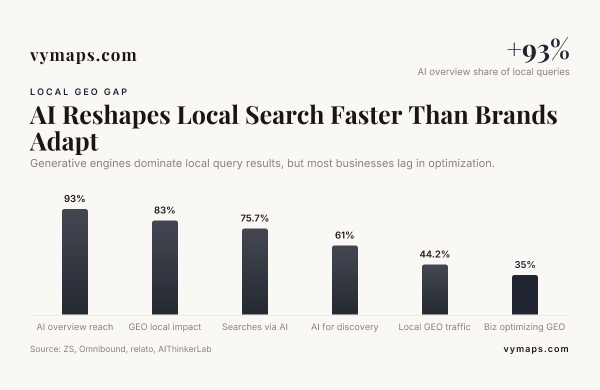
Generative engines dominate local query results, but most businesses lag in optimization.
What we change first
Our order of operations is simple. We start with the parts of the listing most likely to be summarized: services, location cues, hours, and policies.
- Step 1: Rewrite the opening description to include service and location cues in 2-3 sentences.
- Step 2: Add FAQ-style answers inside the listing (common questions, clear boundaries).
- Step 3: Update categories and service labels to match what customers say.
- Step 4: Refresh reviews with a light editorial approach (respond when allowed, and encourage specific feedback).
Examples of GEO-friendly listing content (and what to avoid)
To make Generative Engine Optimization (GEO) for Local Listings easier to apply, we use examples that mirror how local AI recommendations are constructed.
Below are content styles we use and the ones we avoid.
Good: specific “service + location” lines
- “We provide [service] for customers in [neighborhood/city], with [key differentiator].”
- “We handle [common request] and [related request], and we serve [service area].”
Good: “what to expect” paragraphs
- “After you contact us, we confirm the scope, provide an estimate range, and schedule the next steps based on availability.”
Avoid: vague claims without details
- “We are the best in town.” (No supporting details.)
- “Quality guaranteed.” (What does it mean in practice?)
- Long walls of text with no service boundaries or policies.
If we do not include the details customers ask for, the AI assistant has less to work with. That reduces the chance your business is used as an answer source in 2026.
Where to start: practical first audits for local teams
If you want Generative Engine Optimization (GEO) for Local Listings results in 2026, we recommend starting with an audit that is built for action, not spreadsheets.
We focus on what an AI assistant needs to recommend you correctly, especially for “near me” style questions and service-specific queries.
Audit the listing sections that get reused
- Business description: rewrite for clarity, service specificity, and local cues.
- Services and categories: align labels to common customer phrasing.
- Hours and policies: make sure they are unambiguous.
- Service area: add the right boundaries (do not be generic).
Audit your “question coverage”
We review whether your listing answers the most common questions customers ask during discovery. If a question is missing, we add a short, direct answer in FAQ form.
Audit consistency across directory-style profiles
Because businesses like VyMaps show structured directory details, we treat these profiles as part of your overall answer system. For directory-style coverage, you can review your presence on VyMaps and similar services, then update what matters.
Also, if you want a helpful guide framework for GEO for local contexts, we often reference local GEO strategies to increase AI visibility when training internal teams.

Conclusion
Generative Engine Optimization (GEO) for Local Listings in 2026 is about making your local details easy for AI assistants to use accurately. We do this by writing quote-ready listing content, adding proof that matches user intent, keeping details consistent across platforms, and turning changes into a measurable listing plan.
If you apply these steps, you give local AI recommendations a reason to include your business, not just generic categories, when customers ask what to do next.
Frequently Asked Questions
What is Generative Engine Optimization (GEO) for Local Listings in 2026?
Generative Engine Optimization (GEO) for Local Listings in 2026 means formatting and maintaining your local listing details so AI summaries can accurately use them. We focus on quote-ready service facts, clear policies, and consistent location cues to support AI search visibility and local AI recommendations.
How do I improve AI search visibility for my business listings without changing my whole website?
You can start with Generative Engine Optimization (GEO) for Local Listings by rewriting listing sections that AI tends to reuse, like your description, services, hours, and FAQs. Add specific service boundaries and local cues, then keep the same details consistent across your directory profiles.
What should we add to local listings to get included in AI answers?
We recommend adding clear service categories, “what to expect” guidance, and FAQ-style answers that match common discovery questions. This is the practical side of Generative Engine Optimization (GEO) for Local Listings, because it gives AI more reliable content to cite.
Is GEO optimization 2026 worth it for small local businesses?
Yes, because Generative Engine Optimization (GEO) for Local Listings helps when users get direct answers from AI instead of clicking through. Even small businesses can benefit from being included with correct details, especially when listings are consistent and specific.
How do we measure results from Generative Engine Optimization (GEO) for Local Listings?
We track listing updates alongside real-world outcomes like calls, appointment requests, and direction requests. Since AI-driven journeys can show zero-click behavior in 2026, we focus on actions that happen after the summary stage and use ongoing listing audits for continuous improvement.
What are the biggest mistakes in Generative Engine Optimization (GEO) for Local Listings?
The biggest mistakes are vague descriptions, missing service boundaries, unclear policies, and inconsistent hours or address formats. For Generative Engine Optimization (GEO) for Local Listings, we want your facts to be easy to extract and hard to contradict.
Which resources help teams learn GEO optimization 2026 for local listings?
We often point teams to practical GEO guides and local strategy breakdowns like a comprehensive guide to generative engine optimization (GEO) and local GEO strategies to increase AI visibility. Then we apply those ideas directly to your listing sections, not just theory.
About the Author:
 Jopie Liputra is an avid traveler and passionate explorer who loves discovering new places and cultures. When not traveling, Jopie dives deep into travel blogs and official resources to uncover hidden gems and the best things to do in destinations around the world. His articles are a blend of personal experience and meticulous research, perfect for inspiring your next adventure. Connect with Jopie on LinkedIn.
No comments yet. Be the first to add a review.