Master Your Global Hyperlocal Search Strategy to Drive Foot Traffic in 2026

Establishing a robust Global Hyperlocal Search Strategy is the most effective way for modern businesses to connect with customers in their immediate physical vicinity. We have observed that 46% of all global search volume now carries specific local intent, meaning nearly half of your potential audience is actively looking for products and services within walking or short driving distance.
Key Takeaways
| Strategy Component | 2026 Impact Level |
|---|---|
| Real-time Inventory Accuracy | Critical for conversion |
| Mobile-First Accessibility | Essential for foot traffic |
| Cultural Language Nuance | High for global expansion |
| Review Velocity and Recency | Drives consumer trust |
| AI Assistant Discovery | Emerging standard in 2026 |
- How do I start a Global Hyperlocal Search Strategy? We recommend beginning by cleaning up your business data across every global business directory to ensure name and address consistency.
- Why is hyperlocal important in 2026? Consumers now expect immediate, accurate results that reflect exactly what is available at the nearest physical storefront.
- Does location accuracy matter for international brands? Yes, a single set of incorrect hours can ruin a customer's experience and damage your brand reputation globally.
The Evolution of the Global Hyperlocal Search Strategy
In 2026, the way people find businesses has shifted from broad queries to extremely specific, location-based requests. We see that consumers no longer just look for "coffee shops" but instead look for "coffee shops open now with outdoor seating within 500 meters."
A successful Global Hyperlocal Search Strategy requires a deep understanding of these micro-moments. It involves managing digital footprints for hundreds or thousands of locations simultaneously while maintaining a personal, local feel for each one.
We believe that proximity is the new loyalty. If your business is the easiest to find and provides the most accurate information in a specific moment of need, you win the customer's trust.
Building a Reliable Global Business Directory Presence
A strong foundation for your strategy starts with being visible where your customers are looking. This means your presence on a global business directory must be comprehensive, including up-to-date photos, service descriptions, and accurate map coordinates.
We suggest that businesses treat their directory listings as a living extension of their physical storefront. When you update your holiday hours or add a new seasonal menu, those changes should be reflected across all platforms instantly.
Consistency across these platforms is non-negotiable. Discrepancies in phone numbers or street addresses confuse both customers and the automated systems that help people discover new businesses.
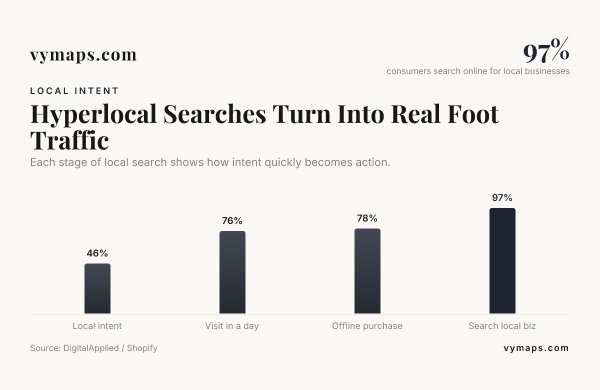
Each stage of local search shows how intent quickly becomes action.

Data Accuracy: The Core of Your Global Hyperlocal Search Strategy
Data is the fuel that powers modern discovery. In 2026, even a minor error in your store's longitude or latitude can lead a customer to a parking lot three blocks away from your actual door.
We emphasize that maintaining high-quality data is an ongoing process rather than a one-time setup. Automated systems constantly crawl the web for information, and if they find conflicting data, your visibility may decrease.
Beyond basic contact info, your Global Hyperlocal Search Strategy should include specific attributes like wheelchair accessibility, Wi-Fi availability, or pet-friendly policies. These details help customers filter their options and choose you over a competitor who provides less information.
We also encourage businesses to use high-resolution images that show the interior and exterior of the building. Visual confirmation helps customers feel confident that they are in the right place when they arrive.
Mobile Experience and Instant Discovery
Most hyperlocal searches happen on mobile devices while people are on the move. Your digital presence must be optimized for small screens and quick loading times to capture this mobile-first audience.
We have found that users in 2026 have very little patience for slow-loading maps or unresponsive buttons. Every second of delay increases the likelihood that a customer will look for a different nearby option.
Click-to-call buttons and integrated driving directions are essential features for your location pages. These tools remove friction from the customer journey and make it as easy as possible for them to reach you.
Optimizing for Voice and AI within a Global Hyperlocal Search Strategy
The rise of AI assistants has changed the way we approach a Global Hyperlocal Search Strategy. People are increasingly using natural language to ask their phones or smart home devices for recommendations.
We must ensure that our business descriptions are written in a way that answers conversational questions. Instead of just listing "Italian Restaurant," we include phrases like "best place for authentic pasta in downtown London."
AI tools rely on structured data to provide answers to users. By using standardized formats for your business information, you make it easier for these AI systems to recommend your business as the best local solution.

The Importance of Localized Reviews and Reputation
In 2026, social proof is localized. A customer in Tokyo may not care about reviews from a store location in New York, so your Global Hyperlocal Search Strategy must prioritize reviews for each individual site.
We recommend actively encouraging customers to leave reviews at the specific location they visited. Responding to these reviews locally shows that the business is active and cares about its community.
Managing reputation at scale can be difficult, but it is necessary for maintaining trust. A store with a 4.8-star rating and 500 local reviews will always outperform a store with no local feedback.
Integrating Community-Specific Content
Hyperlocal means more than just a map pin; it means being part of a neighborhood. We suggest creating content that highlights your involvement in local events or partnerships with other nearby businesses.
This localized content helps build a narrative around each of your physical locations. It signals to both customers and discovery platforms that your business is a relevant and active participant in the local area.
Whether it is sponsoring a local sports team or hosting a neighborhood workshop, these activities should be documented online. This adds a layer of authenticity to your Global Hyperlocal Search Strategy that a generic corporate profile cannot match.
Measuring the Success of Your Global Hyperlocal Search Strategy
We cannot improve what we do not measure. Tracking the performance of your hyperlocal efforts involves looking at metrics like direction requests, phone calls, and actual foot traffic data.
In 2026, we have access to more sophisticated tools that can attribute a physical store visit back to an initial online search. This data allows us to see exactly which parts of our strategy are driving the most value.
Regularly auditing your presence on every global business directory is also a form of measurement. We look for "data drift," where information slowly becomes outdated or is overwritten by third-party sources.

Consistency Across Every Global Hyperlocal Search Strategy
As businesses grow into new regions, maintaining a consistent Global Hyperlocal Search Strategy becomes a logistical challenge. We solve this by using centralized management tools that allow for local flexibility within a global framework.
Each region may have different cultural expectations for how a business presents itself. For example, the tone of a listing in Berlin might be more formal than one in Los Angeles, even if the brand is the same.
We believe the most successful global brands are those that can speak the local language of every neighborhood they inhabit. This cultural competence is a key differentiator in 2026's competitive landscape.
Conclusion
A well-executed Global Hyperlocal Search Strategy is no longer an optional marketing tactic but a fundamental requirement for business survival in 2026. By focusing on data accuracy, mobile accessibility, and local community engagement, we can ensure that our businesses are always found by those who need them most.
The transition toward more precise, AI-driven discovery means that our digital and physical worlds are more connected than ever. When we master the art of being "hyperlocal," we create seamless experiences that turn distant searchers into loyal, local customers.
Frequently Asked Questions
Is a Global Hyperlocal Search Strategy worth it for small businesses in 2026?
Absolutely, because smaller businesses often have a tighter connection to their local community which makes them highly relevant for hyperlocal queries. Focusing on precise location data and local reviews can help a small shop compete effectively with much larger national chains.
How often should I update my global business directory listings?
We recommend reviewing your core business information at least once a month or immediately whenever a change occurs in your store operations. Regular updates to photos and seasonal details keep your listing fresh and signal to discovery tools that your business is active.
What is the biggest mistake in a Global Hyperlocal Search Strategy?
The most common error is having inconsistent NAP (Name, Address, Phone) data across different websites and apps. These discrepancies confuse customers and reduce your overall visibility because discovery systems cannot verify which version of your information is correct.
Can I manage a Global Hyperlocal Search Strategy without specialized software?
While you can manually manage a few locations, it becomes nearly impossible to maintain accuracy for dozens of stores without some form of automation. In 2026, most successful brands use centralized platforms to sync their data across the entire web simultaneously.
Do social media profiles count as part of a hyperlocal strategy?
Yes, location-tagged posts and local business pages on social platforms are vital components of modern discovery. They provide additional signals about your business activity and offer another way for local customers to find and interact with your physical store.
How does voice search affect my Global Hyperlocal Search Strategy?
Voice search often uses longer, more natural phrases, so your business information should include conversational keywords and clear answers to common questions. Ensuring your business is listed with accurate "near me" markers is essential for being the top result in voice-assisted queries.
About the Author:
 Jopie Liputra is an avid traveler and passionate explorer who loves discovering new places and cultures. When not traveling, Jopie dives deep into travel blogs and official resources to uncover hidden gems and the best things to do in destinations around the world. His articles are a blend of personal experience and meticulous research, perfect for inspiring your next adventure. Connect with Jopie on LinkedIn.
No comments yet. Be the first to add a review.