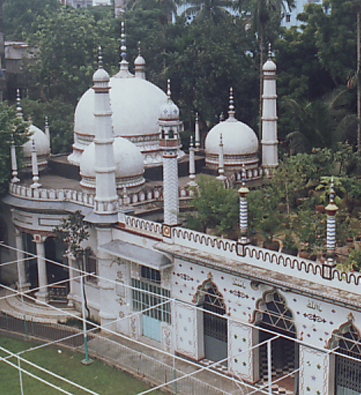
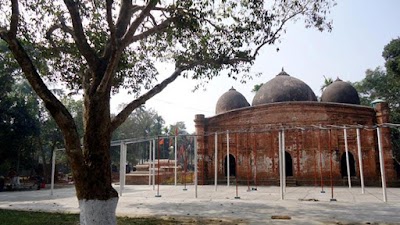
Austagram Kutub Shahi Central Mosque
Austagram, Nikli - Austagram Rd, AstagramAbout
Location :
Added by Jopie, at 29 October 2015
Gallery





Add missing information
13 Reviews
-
27 September 2019
Very good place to visit and a historical place also
response / report this review -
08 September 2019
This is an ancient mosque of that time when mughal empire happened!
response / report this review -
11 March 2019
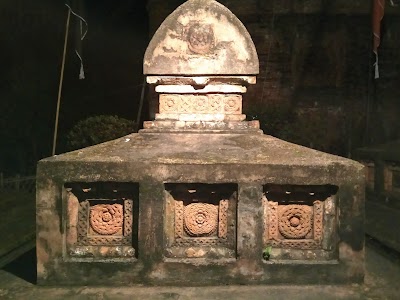
Kutub Shahi Mosque is one of the oldest historical Mosque in Bangladesh.There is a doubt available between the scholars regarding the building period of the mosque. Some believe its 16th century and some believe it’s from 17th century. Whatever it is, the mosque was built by a saint named Kutub Shah, and the name of the mosque is taken after him. His grave is located exactly beside the mosque along with other of his companions (locals’ assumption).
response / report this review -
26 August 2018
This is a beautiful religious place for Muslims.But all kinds of religious peoples from different religion can pass time in there
response / report this review -
05 February 2018
One of the oldest historical mosque In Bangladesh.
response / report this review -
08 November 2017
This century old Mosque build between 16th to 17th century. It's an architecture of Mughals and Sultani era.
response / report this review -
30 October 2017
It's a historical place..
response / report this review -
07 July 2017
Ancient Mosque
response / report this review -
07 April 2017
Nice village and mosjid
response / report this review -
13 January 2017
nice
response / report this review -
10 December 2016
Austagram Mosque - Austagram, Kishoreganj
Austagram Mosque a five-domed structure, extensively referred to as Qutb Shah's Mosque, is positioned in the Bhati area of provide Kishoreganj district. Restored and repaired by way of the dept of Archaeology, Bangladesh, the mosque has now been given a better look. This is a brick-built oblong structure measuring 13.72m through 7.62m at the out of doors.
The four exterior angles of the development are strengthened by octagonal towers, which get up to the roof stage. The curvature of the battlements and cornices are over-emphasised. The eastern facade is pierced with 3 -targeted pointed archways, whilst the south and north partitions each has two equivalent arched-doors.
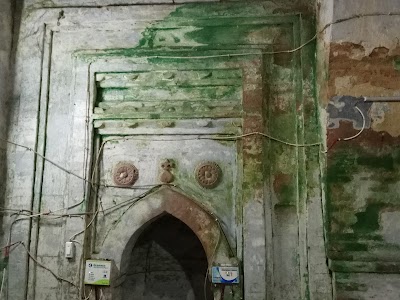
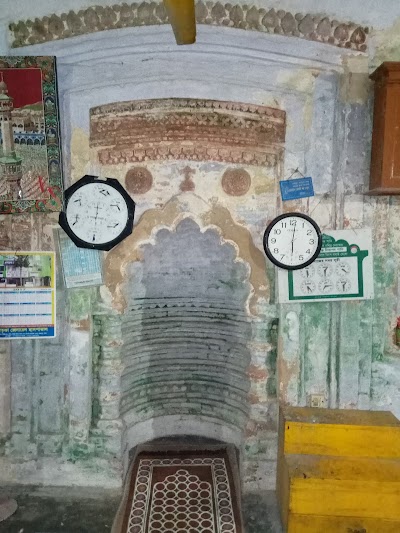
Inside, the western wall comprises three semi-circular mihrabs, of which the important one is larger and displays a rectangular projection out of doors having spherical pinnacles on its angles. the interior of the mosque, a unmarried rectangular hall of 10.97m through 4.88m, has been very cleverly divided into 5 sq. bays - a large one in the centre and a couple of smaller ones on all sides. The architect had first marked off the vital square bay via erecting two extensive transverse arches from the top of the engaged brick pillars at the west and east partitions and lined it with a large hemispherical dome on Bengali pendentives. Then each of the flanking oblong bays was then divided into equal square parts by way of putting an additional arch between the east-west transverse arches and the aspect walls. Those small square bays are lined with small bubble-formed domes, which are carried on the standard Sultanate Bengali pendentives. The construction has due to this fact a total of 5 domes - a large one within the centre and two smaller ones on all sides of the significant dome.
The mosque used to be originally decorated with terracotta ornamentation, lines of that are nonetheless visual in the mihrab niches, and the outer facades. The exterior facades are embellished with rectangular panels between the doors. The panels are arranged perpendicularly, one above the opposite. Each one of those panels has a cusped arch motif, and presentations types of terracotta designs. Identical panels are also noticed on the facets of the nook towers, which can be divided into sections by means of stunning mouldings. All the doorways are contained within rectangular frames. The spandrels of doorway arches are ornamented with scroll-works with rosettes, even as above are degrees of mouldings.
The mosque is not dated by means of inscription. Native legends ascribe the construction to the saint Qutb Shah, whose tomb is close to through. However at what time the saint flourished right here and built the mosque isn't recognized.
then again, the constructional and ornamental aspects of the development, such as the curved cornice, the semi-round mihrab niches, the two concentrated pointed arches, the corner towers emerging as much as the roof stage, terracotta ornamentation and the panel decorative designs at the outer surface of the partitions, suggest that it's a made from the Sultanate period and may be dated roughly in the second one part of the sixteenth century.
Crucial facet of the development is that it marks the beginning of a novel variety of five-domed mosques in Bengal. not like the Tenga Iswaripur Mosque (c early 17th century) at Iswaripur in Sathkhira and the Kartalab Khan's Mosque (1700-04) at Dhaka, wright here 5 domes are in the same line, the existing example displays a big dome within the centre and four small ones on the 4 corners. The type gradually evolved within the land, as we will be able to see from the Sarail Hatkhola Mosque (1663) in Brahmanbaria and the Walipur Alamgiri Mosque (1692) in Comilla. One of these mosque layouts in Bengal could also be instructed to have been derived from the five-domed Jamat Khana Mosque (c 1310-16) on the Dargah of Nizamuddin Aulia in Delhi.
Collected by: Tanvir Alam Johnyresponse / report this review -
11 July 2016
This is basically a five dome mosque. One larger dome is at the center, and other four domes are near at the corner of the mosque.
response / report this review -
05 November 2015
Historical architecture
response / report this review