Why Pharmacy Proximity Determines Your Travel Neighborhood Safety

Why Pharmacy Proximity Determines Your Travel Neighborhood Safety
Nearly 48.4 million Americans, or 1 in 7 people, currently live in what researchers call a pharmacy desert. When we help travelers find pharmacies near me and across the country, we see firsthand why pharmacy proximity determines your travel neighborhood safety long before anyone thinks about hotel reviews or crime statistics.
Key Takeaways
| Question | Answer |
|---|---|
| Why does pharmacy proximity determine your travel neighborhood safety? | Distance to a pharmacy affects how fast you can get medication, first aid supplies, or emergency guidance, which directly shapes how safe a neighborhood feels during a trip. |
| How many Americans live far from a pharmacy? | About 1 in 7 people live in a pharmacy desert, according to GoodRx research. |
| What is the average travel time in a pharmacy desert? | Nonmetropolitan residents average an 85-minute round trip covering 36 miles to reach the nearest pharmacy. |
| Do rural or urban neighborhoods have better pharmacy access? | Urban areas average over 78 pharmacies per 10,000 residents while rural counties average only 1.72. |
| Is proximity alone enough to judge safety? | No. Staffing pressure inside pharmacies also affects safety, so proximity and pharmacy quality both matter. |
| Where can I check pharmacies near me before booking a trip? | Use a location-based directory like our pharmacy near me finder to map coverage before you travel. |
| Are pharmacy closures making this worse in 2026? | Yes. Over 1,300 pharmacies have closed nationwide in the past five years, shrinking safe-access zones in many neighborhoods. |
Why Pharmacy Proximity Determines Your Travel Neighborhood Safety in 2026
We treat pharmacy access as one of the clearest, most measurable signals of neighborhood safety. It is not about how a street looks at night.
It is about how quickly a traveler can get insulin, an inhaler refill, or basic wound care if something goes wrong.
Hotels, rental listings, and travel blogs rarely mention pharmacy distance. Yet it shapes real outcomes for travelers with chronic conditions, families with young children, and older adults, all of whom rely on quick access more than most local review sites acknowledge.
This is exactly why pharmacy proximity determines your travel neighborhood safety in ways that generic safety scores miss entirely.
What Counts as a Pharmacy Desert (and Why It Matters for Travelers)
A pharmacy desert is generally defined as an area where residents must travel unusually far to reach the nearest pharmacy. Researchers at PolicyMap and GoodRx have mapped these zones across the country.
For travelers, the definition matters just as much as it does for residents. A neighborhood that looks charming on a map can still leave you an hour or more from the nearest open pharmacy.
- Nonmetropolitan pharmacy deserts: average 85-minute round trip, 36 miles total.
- Extreme cases: Apache County, Arizona sees average round trips exceeding 3 hours for roughly 87,000 residents.
- Urban vs. rural density: rural counties have 1.72 pharmacies per 10,000 residents versus over 78 in large metro areas.
These numbers explain why checking pharmacy coverage should be part of any pre-trip safety check, right alongside checking crime data or reading neighborhood reviews.

The Real Distance Between Safety and a Pharmacy Near Me
Distance sounds abstract until you need it in an emergency. A pharmacy that is technically "in the area" but 10 or more miles away functions very differently from one within walking distance.
According to Pharmacy Times research, while 88.9% of the U.S. population lives within 5 miles of a community pharmacy, only 48.1% live within a single mile. That gap is critical for travelers without a rental car or reliable rideshare access.
In 8.3% of U.S. counties, at least half of residents live more than 10 miles from the nearest community pharmacy. If you are traveling through one of these counties, a minor medical issue can quickly become a logistics problem.
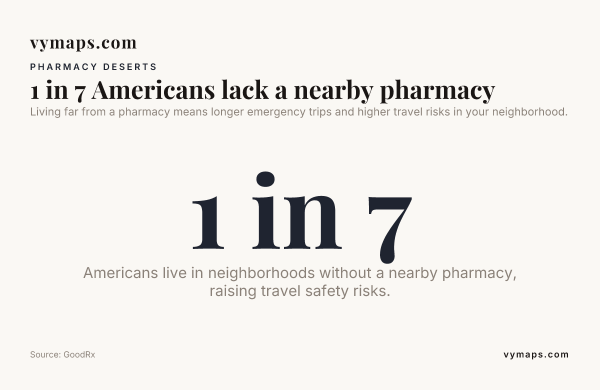
Living far from a pharmacy means longer emergency trips and higher travel risks in your neighborhood.
How Rural and Urban Neighborhoods Compare on Pharmacy Access
We consistently see the same pattern when comparing rural and urban listings across our directory: density predicts access, and access predicts safety.
Rural counties simply have fewer pharmacies per resident, which stretches emergency travel times for anyone passing through, not just locals.
| Area Type | Pharmacies per 10,000 Residents | Typical Travel Impact |
|---|---|---|
| Rural counties | 1.72 | Long round trips, limited late-night options |
| Large metro areas | 78+ | Multiple options within a short walk or drive |
| Nonmetropolitan deserts | Varies, often near zero within range | Average 85-minute round trip, 36 miles |
This is another reason why pharmacy proximity determines your travel neighborhood safety more reliably in rural stretches than raw population figures alone.
Pharmacy Deserts and Emergency Response: A Growing Risk in 2026
Pharmacy deserts are not shrinking this year. They are expanding.
The CDC reported that Minnesota alone lost 13% of its community pharmacies between 2009 and 2024, a trend mirrored across much of the Midwest. Nationally, more than 1,300 pharmacies have closed in the last five years.
Every closure widens the radius a traveler must cover to reach medication, first aid, or a pharmacist who can advise on a health concern. For neighborhoods already stretched thin on services, each closure raises the practical safety risk for anyone visiting or passing through.
Safety Culture Inside Pharmacies: Another Layer of the Puzzle
Proximity alone does not guarantee a safe experience once you reach a pharmacy. Staffing pressure and pace inside the pharmacy itself also affect outcomes.
Research published through PubMed Central found that the safety culture composite covering staffing, work pressure, and pace scored just 37.6% positive, the lowest of any measured category in community pharmacies. That is a meaningful signal for anyone relying on a rushed, understaffed location during a trip.
On the flip side, familiarity between staff and patients strongly improves outcomes. That is one more reason we encourage travelers to look for pharmacies with consistent staff and steady operating hours, not just the nearest storefront on a map.

How to Check Pharmacy Proximity Before You Travel
We recommend building pharmacy checks into your pre-trip routine the same way you would check hotel reviews or transit options.
- Search your destination neighborhood using a pharmacy near me search for the U.S. before booking accommodation.
- Note whether the nearest listed pharmacy is within walking distance or requires a car.
- Check operating hours, since many rural pharmacies close early or are not open on weekends.
- If traveling internationally, browse country-specific directories such as our listings for the United Kingdom, Canada, or India.
- Confirm backup options in case your first choice is closed or out of stock.
This kind of pre-trip check is a practical example of why pharmacy proximity determines your travel neighborhood safety in a way that is easy to plan around once you know to look for it.
Finding Pharmacies Near Me: Directories and Tools That Help
Locating reliable pharmacies while traveling should not require guesswork. We built our directory so travelers can browse verified pharmacy listings by location rather than relying on outdated map pins.
Our pharmacy directory and broader pharmacies listings cover addresses, categories, and location data across regions, which makes it easier to compare options before you arrive somewhere new.
For a more location-specific search, our near me pharmacy locations page and pharmacy category listings let you filter by proximity rather than scrolling through unrelated results. If you manage or know of a pharmacy that should be listed, you can also submit it to our directory so more travelers can find it.
What Travelers With Chronic Conditions Should Know
Travelers managing diabetes, asthma, heart conditions, or other chronic issues face the highest stakes when pharmacy access is limited.
A missed refill in a pharmacy desert is not a minor inconvenience. It can mean a multi-hour round trip, as seen in Apache County, Arizona, where average travel times exceed 3 hours for tens of thousands of residents.
Before booking a stay in an unfamiliar neighborhood, checking pharmacy distance is as important as checking whether the area has reliable transportation.
We suggest packing a slightly larger supply of essential medication when traveling to rural or nonmetropolitan areas, given how thin pharmacy coverage can be once you leave major metro corridors.
Comparing Neighborhood Safety Signals: Pharmacy Proximity vs. Other Metrics
Crime statistics and walkability scores get most of the attention in travel safety guides. Pharmacy proximity deserves equal weight.
| Safety Signal | What It Measures | Limitation for Travelers |
|---|---|---|
| Crime rate | Reported incidents in an area | Does not reflect medical emergency response capability |
| Walkability score | Ease of moving on foot | Ignores whether a pharmacy exists within that walkable range |
| Pharmacy proximity | Distance and travel time to medication access | Requires checking directories, but directly affects emergency outcomes |
None of these metrics work well alone. Combining them gives a far more complete picture of how safe a neighborhood truly is for a visiting traveler.
Conclusion
Pharmacy access is not a minor travel detail. It is one of the clearest, most overlooked reasons why pharmacy proximity determines your travel neighborhood safety, whether you are visiting a major city or a small rural town.
With 1 in 7 Americans living in a pharmacy desert and closures continuing into 2026, checking pharmacy coverage before you travel is a small step that can prevent a serious problem later.
We built our directory to make that check simple. Browse our pharmacy location listings or explore country pages for the United States and the Philippines before your next trip, and factor pharmacy proximity into your safety planning the same way you would check any other neighborhood detail.
Frequently Asked Questions
Why does pharmacy proximity determine your travel neighborhood safety in 2026?
Pharmacy proximity affects how quickly travelers can access medication, first aid supplies, and professional health advice during an emergency. Neighborhoods with long travel times to the nearest pharmacy carry higher practical safety risk, regardless of how the area looks or scores on other metrics.
How far is too far from a pharmacy when traveling?
Research shows only 48.1% of Americans live within one mile of a pharmacy, and in 8.3% of counties, half the residents live more than 10 miles away. Anything beyond a 10-mile stretch, especially without a car, should be treated as a meaningful travel safety concern.
Are pharmacy deserts getting worse this year?
Yes. Over 1,300 pharmacies have closed nationwide in the past five years, and states like Minnesota lost 13% of their community pharmacies between 2009 and 2024. This trend is expanding the number of neighborhoods where pharmacy proximity determines your travel neighborhood safety more than ever.
Do rural areas have worse pharmacy access than cities?
Yes, significantly. Rural counties average only 1.72 pharmacies per 10,000 residents compared to more than 78 in large metropolitan areas, which means much longer travel times during emergencies.
Can I check pharmacy proximity before booking a hotel or rental?
Yes. Using a location-based directory to search pharmacies near me for your destination before booking lets you confirm access ahead of time rather than discovering a gap after you arrive.
Is pharmacy staffing also a safety factor, or just distance?
Both matter. Distance determines how long it takes to reach help, while internal staffing pressure (measured at just 37.6% positive safety culture in one national study) affects the quality of care once you get there.
What should travelers with chronic health conditions do about pharmacy deserts?
Travelers managing conditions like diabetes or asthma should check pharmacy distance before departure, carry extra medication when heading into rural or nonmetropolitan areas, and identify backup pharmacy options along their route.
About the Author:
 Jopie Liputra is an avid traveler and passionate explorer who loves discovering new places and cultures. When not traveling, Jopie dives deep into travel blogs and official resources to uncover hidden gems and the best things to do in destinations around the world. His articles are a blend of personal experience and meticulous research, perfect for inspiring your next adventure. Connect with Jopie on LinkedIn.
No comments yet. Be the first to add a review.