About
Location :
Added by Jopie, at 15 December 2016
Gallery


Add missing information
12 Reviews
-
19 March 2019
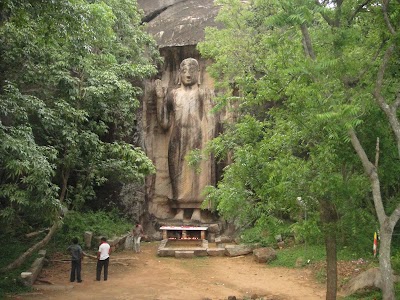
The Ras Vehera statue is also known as Sas-seruwa as well as Sasuruwa and very equal to famous Awukana statue, however not much popular like Awukana.
It is believed that the 39 feets statue was built during the era of Great King Mahasen, 3-4 century and had not been finished due to unknown reason.response / report this review -
10 February 2019
This was one of an outstanding creations found in Sri Lanka
response / report this review -
09 January 2019
Sesuruwa means what is similar, as the Ras Vehera statue bears similar profiles to the Aukana Buddha statue. But there is a world of difference between the sculpturing structure of these two Buddha statues.
While the Aukana Buddha statue is 46 feet high, the Sesuruwa/Ras Vehera one is 36 feet high. This Ras Vehera statue is carved into a rectangular frame in the rock boulder itself. The siraspota is absent there, while it is portrayed in dots for the hair. The Aukana Buddha statue stands on a stone pedestal in the form of an exquisite lotus symbol. While that of the Ras Vehera statue stands on a plain rectangular stone pedestal.
The symbolic mudras (gestures) depicted here differ from each other. The Aukana Buddha statue has the Ashiva Mudra (giving of a blessing), while in the Ras Vehera one, the Mudra is in the form of Abhaya Mudra (meaning freedom from fear or fearlessness). For all visual purposes, from the sculptured features on the Ras Vehera Buddha statue it appears that it was left in an unfinished state of sculpturing for some unknown reason.
Some attribute these to have been constructed by king Dhatusena of the 6th century AD, when he was living in a temple called Sinhagiri Vihara. Still others say it was built during the epic reign of King Parakrama Bahu, the Great of the 13th century, AD. The Ras Vehera Statue also dates back to the 12th-13th century AD. As regards the canopy constructed over the Aukana Buddha in the past, there are diversified views expressed by archaeological authorities, as regards to its removal. It is learnt from the Archaeological Department sources (its Advisory Board) had approved its removal. Some say that removing such an overhead roof would be damaging to the statue, as then it would be exposed to the natural elements like sun, rain and wind. From ancient times, the statue had been kept open sans any canopy over it. Consequently, it was quite exposed to the rigours of time, wear and tear of even the natural phenomenon like rain, sun and wind. In conclusion let me mention one unique feature of its sculpturing the Aukana Buddha statue.
According to local traditions, they say that the degree of accuracy of sculpturing it was such that if a drop of water (meaning rain water), detaching itself from the the tip of its nose would drop in perpendicular into the small depression (if there is no blowing), carved between its big toes. That depression is still to be seen carved out in that fashion between the toes.response / report this review -
03 January 2019
Must visit for all, though nearest main road is about 15km away. Good to go when shine room is open. Be careful in following Google maps as it prefers to put you on a gravel road. Ask locals for direction as there is a newly laid road.
response / report this review -
10 October 2018
Nice place and this statue similar to AUKANA statue but not popular than aukana.
response / report this review -
18 April 2018
This statue of Buddha is sort of simillar to the Aukana Buddha statue. A must see if you are visiting Aukana or Anuradhapura.
response / report this review -
13 March 2018
Unfinished statue of load Buddha.. same era of Aukana statue
response / report this review -
03 January 2018
Super
response / report this review -
25 October 2017
This is well known Raswehera Gautama Buddha Statue.
response / report this review -
15 June 2017
A beautiful ancient temple, 1 to 2 BC. Has very nice temple paintings some belonging to the Kandyan era which more recent.
response / report this review -
30 April 2017
Historic plase
response / report this review -
22 December 2016
The sleeping buddha statue in the cave temple was built after dressing a real siura (Buddhist monks dress) to statue and apply clay paint on it. Back side of the statue you can see some theads of the underlying cloths in the exposed areas. This is probably the only statue made like this.
response / report this review


