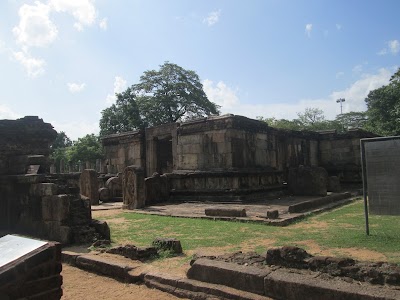
Hetadage
Sacred City, PolonnaruwaAbout
Location :
Added by Jopie, at 18 June 2016
Opening Hours
- Monday 7:00 AM – 8:00 PM
- Tuesday 7:00 AM – 8:00 PM
- Wednesday 7:00 AM – 8:00 PM
- Thursday 7:00 AM – 8:00 PM
- Friday 7:00 AM – 8:00 PM
- Saturday 7:00 AM – 8:00 PM
- Sunday 7:00 AM – 8:00 PM
Gallery




Add missing information
14 Reviews
-
12 May 2018
This is more that 1000 years old
response / report this review -
21 February 2018
This is an ancient shrine which housed the tooth relic during the Polonnaruwa Kingdom. According to the inscriptions on a stone slab next to this building, this building has been built by King Nissanka Malla (1187-1196) to house the tooth relic of Buddha. But it is unclear whether this was built by king Parakramabahu (1153-1186) and was renovated by Nissanka Malla (1187-1196) or whether Nissanka Malla (1187-1196) himself built it. Reason for this doubt is the description of a large relic house built by Parakramabahu (1153-1186) in the chronicles and inability to find this in the Polonnaruwa area. Also King Nissanka Malla (1187-1196) is well-known for taking the credit for things others have done by just doing renovation work.
This building is much larger than the Atadage and is surrounded by solid stone walls. In design it is similar to Atadage with two floors. Stone steps to the upper floor are still in place. The upper floor has been probably made out of wood and the tooth relic would have been housed here. On the ground floor remains of three standing Buddha statues can be seen.
“Heta” means sixty and because of this, it is presumed that this building was called by this name because it was completed in sixty days or it housed sixty relics with tooth relic of Buddha.
Another important factor of this building is the Sandakada Pahana (the moonstone) at the entrance. This is a rare instance of a lion appearing on the moon stone. Generally the lion and the bull is not seen in the moonstones in the Polonnaruwa Era.response / report this review -
12 January 2018
This was again built at Polonnaruwa era and still the real owner of this is uncleared. However, this is more than 1000 years old now. This was assumed to be used as the temple tooth in Polonnaruwa era.
Building is not in a good form, however, still the pride is visible with the remains there. purely a stone construction and no evidence is there to judge the type of roof of this buildingresponse / report this review -
01 January 2018
Great history of Sri Lanka.
response / report this review -
01 December 2017
Hatadage (Sinhala: හැටදාගේ) is an ancient relic shrine in the city of Polonnaruwa, Sri Lanka. It was built by Nissanka Malla, and had been used to keep the Relic of the tooth of the Buddha. The Hatadage had been built using stone, brick and wood, although only parts of the brick and stone walls now remain. It appears to have been a two-storey structure, but the upper storey has now been destroyed. Three Buddha statues carved out of granite rock are located within a chamber of the shrine.
response / report this review -
09 September 2017
Hatadage (Sinhala: හැටදාගේ) is an ancient relic shrine in the city of Polonnaruwa, Sri Lanka. It was built by Nissanka Malla, and had been used to keep the Relic of the tooth of the Buddha.
response / report this review -
04 September 2017
Wonderful building
response / report this review -
22 August 2017
This is an historic place in sri kanka. Lot if things to learn about polonnaruwa era. Once this was a 7 story castle. Now it is ruined. Even though you can still see the majestic look through the ruins. It is beyond our imagination..
response / report this review -
15 July 2017
Built by King Nishshankaamalla next to Sath mahal Prasada. Apart from the rooftop other parts of the building is still preserved. Worth watching
response / report this review -
04 April 2017
Words cant do justice to this place
response / report this review -
26 March 2017
Heta-dageya, The name 'Heta' mean this was build in 60 sri lanka ours. (1 sri lanka our is longer than standard hour). 'dageya' mean stupa. All made by heavy rock blocks.
response / report this review -
07 February 2017
This is an ancient shrine which housed the tooth relic during the Polonnaruwa Kingdom. According to the inscriptions on a stone slab next to this building, this building has been built by King Nissanka Malla (1187-1196) to house the tooth relic of Buddha. But it is unclear whether this was built by king Parakramabahu (1153-1186) and was renovated by Nissanka Malla (1187-1196) or whether Nissanka Malla (1187-1196) himself built it. Reason for this doubt is the description of a large relic house built by Parakramabahu (1153-1186) in the chronicles and inability to find this in the Polonnaruwa area. Also King Nissanka Malla (1187-1196) is well-known for taking the credit for things others have done by just doing renovation work.
This building is much larger than the Atadage and is surrounded by solid stone walls. In design it is similar to Atadage with two floors. Stone steps to the upper floor are still in place. The upper floor has been probably made out of wood and the tooth relic would have been housed here. On the ground floor remains of three standing Buddha statues can be seen.
“Heta” means sixty and because of this, it is presumed that this building was called by this name because it was completed in sixty days or it housed sixty relics with tooth relic of Buddha.
Another important factor of this building is the Sandakada Pahana (the moonstone) at the entrance. This is a rare instance of a lion appearing on the moon stone. Generally the lion and the bull is not seen in the moonstones in the Polonnaruwa Era.response / report this review -
05 August 2016
All visitors are informed to be mindful of the attire. It was a shame to see some foreign nationals in embarresment when the cultural police stopped them from entering without formal the dress code. There are two sides to this. One, that the site is considered holy grounds and thus require certain modesty. However on the other hand tourists are not well informed of local requirments and since they are on tour cannot expect them to carry around a separate set of dress. You will mostly find bikers on tour who will find a pair of shorts more convinent, with a skinny to go with our humid weather. This is a NO NO to the administrators. The Govt. should find a go between.
Another sad situation is the cultural cops in charge cannot manage the language. On my visit to Tadage recently the cop blew a whistel on a touring family. He was exhausting his best English and sign language to explain his point, until both parties were heating up. Finally my wife intervened to translate. Outcome was, an elder boy in the group sacrificing his T-shirt to a lady (maybe his mom) The poor guy had to sit in the scorching sun bare body red in embarresment until the others made the tour without him.
I believe all hotels and restaurents should advise their guests on local requirments as a customer service.response / report this review -
25 June 2016
Ok
response / report this review