About
Location :
Added by Jopie, at 09 February 2017
Gallery


Add missing information
19 Reviews
-
13 April 2020
Hagia Sophia is considered a unique monument in world architecture, and its magnificence and functionality has been a good example in construction of countless Ottoman mosques. Hagia Sophia with its exceptional history constitutes a synthesis between east and west. This monument is one of the wonders of the world that has remained intact until the present day. One can find many attractions in Hagia Sophia – interesting forms of Byzantine architecture, mosaics of the Christian period as well as structures added during the Ottoman era.
Hagia Sophia has been a Christian place of worship for 916 years, then converted into a mosque and served Muslims for 481 years. Hagia Sophia Museum was opened in 1935 and ever since it has been attracting thousands of visitors every year.
According to Byzantine historians (Theophanes, Nikephoros, Grammarian Leon) the first building of Hagia Sophia church was established during the reign of Constantius I (324 – 337 AD). It was a basilica with a wooden roof, and it was burned down during a revolt. Nowadays there is no evidence of this structure.
During the reign of emperor Theodosius Hagia Sophia was built for the second time and opened to the public in 415 AD. The basilica was again burned down during the Nika Revolt in 532 AD. Some ruins of this building were discovered during excavations in 1936. There were stairs indicating the entrance of the building, columns, capitals and other fragments of the building.
Emperor Justinian (527 – 565 AD) wanted to build a church bigger than two previous ones, which would represent the power and magnificence of empire. The new building of Hagia Sophia was designed by two famous architects of that era – Isidoros from Miletos and Anthemios of Tralles. Many columns, capitals, marble and colourful stone were brought to Istanbul from various ancient cities in Anatolia and used in construction works of Hagia Sophia.
The works were commenced on December 23, 532 AD and completed on December 27, 537. The new building consisted of a large central nave and two side aisles, separated by columns, apse, inner and outer narthex. The size of the inner space of basilica is 100 X 70m and it is covered by the magnificent dome (diametre 30.31 m), supported by the four large piers, 55 m high.
Besides the unique architecture of the building, the mosaics are also important artefacts of the period. The oldest mosaics – gold gilded with geometrical and floral designs - may be found in the inner narthex as well as in side naves. Figural mosaics (with images of Jesus Christ, Virgine Maria etc.) from 9th – 12th centuries are located on Emperor Door, apse, exit doors and upstairs gallery.
After the conquest of Istanbul in 1453, the so-called “Turkish period” started, and several repairs were made in Hagia Sophia. The art works surrounding the mihrab includes the best samples of Turkish pottery and calligraphy. The sure is taken from the Koran inscribed on rounded plates of 7.50 m diametre by Kazasker Mustafa İzzet Efendi, a famous Ottoman calligrapher. The names of Allah, Muhammed, Ömer, Osman, Ali, Hasan, Ebu Bekir and Hüseyin are inscribed there. On the sidewalls of mihrab there are plates written and granted by Ottoman sultans.
Tombs of Sultan Selim II, Sultan Mehmet III, Sultan Murat III as well as some of their relatives, fountain of Sultan Mahmut I, primary school, soup kitchen, library, Sultan Abdülmecit's meeting place and the mosque timekeeper’s (astronomer’s) house may be found in the territory of Hagia Sophia Museum. All of the above mentioned objects, especially the tombs with their interior design, pottery and architecture are excellent examples of Ottoman tradition.response / report this review -
23 March 2020
It’s within the Topkapi Palace Walls. Recognizable on Spot because It Will Seems like a Misplaced Peace in that Location. Nothing Fantastic in the Inside but, with Each Stone, It’s Telling the Brutality of History that Passed By
response / report this review -
21 March 2020
I don’t see how so many people giving this place 5 stars. Nothing inside. Almost every door is locked. Can literally spend 2 minutes in here. If have pass, ok go, but do not buy a ticket here. Follow me on google reviews to learn the real truth about all these museums.
response / report this review -
20 February 2020
Though the present church dates only from the 6th century, it is at least the third building to be erected on what is thought to be the oldest site of Christian worship in Istanbul. Within a decade of the Muslim conquest of the city in 1453 it had been incorporated within the Topkapı Palace complex and pressed into use as an arsenal. Today the building, which has good acoustics, is the setting for concerts during the Istanbul Music Festival. Inside are three fascinating features that have not survived in any other Byzantine church in the city. The synthronon, the five rows of built-in seats hugging the apse, were occupied by clergy officiating during services. Above this looms a simple black mosaic cross on a gold background, which dates from the iconoclastic period in the 8th century, when figurative images were forbidden. At the back of the church is a cloister-like courtyard where deceased Byzantine emperors once lay in their porphyry sarcophagi. Most have been moved to the Archaeological Museum
response / report this review -
20 January 2020
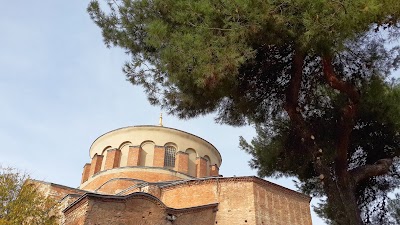
Hagia Irene , sometimes known also as Saint Irene, is a Greek Eastern Orthodox church located in the outer courtyard of Topkapı Palace in Istanbul. It is one of the few churches in Istanbul that has not been converted into a mosque, as it was used as an arsenal for storing weapons until the 19th century.The Hagia Irene today operates as a museum and concert hall.
response / report this review -
17 January 2020
Haghia Irene (Ayairini) Justinian's 6th century Church of Holy Peace, in the outer courtyard of Topkapı Palace, stands on the site of a temple and of the first Christian church in the city, built by Constantine in the 4th century. The basilica became an armoury museum in the 19th century, hence the display of weaponry in the Ottoman painting inside the dome. (Cornucopia Mag. issue 60)
response / report this review -
15 January 2020
Often overlooked by tourists when visiting the Sultanahmet area, this museum which was once a church from the Byzantine times offers its own atmosphere. Once inside, you can feel the eerieness of its massive structural volume with high ceilings. The security guard was a very friendly guy. When my wife and I visited, we were the only people inside and he was nice enough to chat with us (eventhough he barely speaks English) and offered to take a picture of us. Truly wonderful museum!
response / report this review -
03 November 2019
St. Irene is one of the little known treasures of Istanbul. A large and beautiful Byzantine basilica located in Topkapi's first courtyard, just to the left of the entrance. But somehow rushed to Topkapi Palace, many visitors miss out on this jewel from Justinian's time. St. Irina was built before St. Sofia has for some time been the largest and most important church in Constantinople. It is the only surviving church of Byzantine times that has not been converted into a mosque. The church has excellent acoustics and concerts are held there.
response / report this review -
16 April 2018
Byzantine church Aya Irini, the name of "Divine Peace or Holy Peace", is the largest Byzantine church in Istanbul, untouched by the Byzantine church in Istanbul, in the courtyard of Topkapi Palace, next to Hagia Sophia and with it. According to ancient sources, to remain here located Roman period Artemis, benefiting from the ruins of Aphrodite and Apollo temple, 4th century early ı.constantinus (324-337) made timely Hagia Eirene Museum, where it also began the first of museum work in Turkey. Since 1973, it has hosted many art events, especially in İKSV itself.
response / report this review -
13 March 2018
Greek Eastern Orthodox church located in the outer courtyard of Topkapi Palace. It is one of the few churches in Istanbul that has not been converted into a mosque. Nowadays operates as a museum (25 liras) and concert hall.
The church was dedicated by Constantine to the peace of God, and is one of the three shrines which the Emperor devoted to God's attributes, together with Hagia Sophia (Wisdom) and Hagia Dynamis (Power).response / report this review -
19 February 2018
Very old church, one of the few remnants of the Byzantine era. Bit expensive to go in, because all you can see is an empty church.
response / report this review -
19 December 2017
Try to get a ticket to any concert at Hagia Irene - it feels like an astral journey! The acoustics are incredibly amazing. Built in 324, Hagia Irene long served as the largest church in Byzantium and was a cathedral until the first Hagia Sophia church was built.
response / report this review -
24 November 2017
Untouched and unaltered church from the Roman and Byzantine times. Was second largest church in Constantinople.
There were three Hagias constructed in the time.
Hagia Irene, Church of Divine Peace aka Old Church.
Hagia Sophia, Church of Divine Wisdom aka New Church.
Hagia Dynamis, Church of Divine Power (not much of this 4th century church).
This is now used as a museum and concert hall. The faded traces of frescoes depict iconoclast period.
Worth going in if you have museum pass.response / report this review -
04 September 2017
im feeling too much easy to visit every where
response / report this review -
08 June 2017
Only way to go there without feeling scammed is if you have a Museum Card which includes entrance to Hagia Irene, but even then, you will still feel you wasted your time. It makes no sense to pay 20TL just to see the internal part of the plain walls and not much more, besides renovations in progess (for at least 2 years now).They didn't even bother to put any sign describing what you are supposed to see. My advise is to take a look from outside in your way to/from Topkapi Palace, and keep walking.
response / report this review -
20 April 2017
Its interior is very very beautiful (I LIKE )
But its exterior kook like a old
This is very famous place. I can trying to
visit this place. ✈😆response / report this review -
03 April 2017
Agree wholeheartedly with Claudio. I have a Museum Card but it does not cover this building. Go figure! Hagia Irene is like a lot of Istanbul's attractions in that it is tied up in renovations which may never finish. Outside is worth a look, definitely.
response / report this review -
17 February 2017
The fact that they charge 20 lira for a place that is completely covered for renovations is confusing. Such a waste
response / report this review -
16 February 2017
Don't waste 20 lira to go inside. There is absolutely nothing to see inside.
response / report this review