About
Location :
Added by Jopie, at 27 June 2016
Gallery





Add missing information
18 Reviews
-
01 June 2018
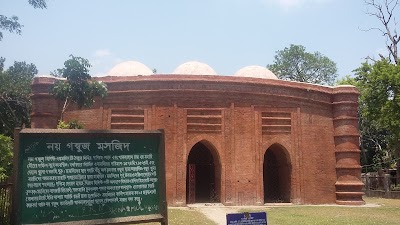
ঠাকুর দিঘী বা খাঞ্জেলী দিঘীরপশ্চিম পাড়ে ১৬.৪৫ মিঃX১৬.১৫মিঃ ভূমি পরিকল্পনায় নির্মিত নয়গম্বুজ মসজিদটি অবসিহত। এর দেয়ালগুলো ২.৫৯মিঃ পুরম্ন। মসজিদ অভ্যমত্মরে দুসারি পাথরের থাম দিয়ে মোট নয়টি চৌকো খন্ডে বিভক্ত । প্রতিটি খন্ডের উপর মসজিদের ছাদের নয় গম্বুজ নির্মিত। পশ্চিমের কিবলা দেয়ালে নির্দিষ্ট দুরতব পর পর একটি করে মোট তিনটি অবতল মিহরাব আছে। এগুলোর টিম্প্যানাম ও স্প্যানাড্রল অংশে পোড়ামাটির কারম্নকাজ লÿ্য করা যায়।
response / report this review -
30 April 2018
The Nine Dome Mosque is a historic mosque in Bagerhat, Bangladesh. It was built in the fifteenth century by a Mughal general on orders from Babur himself and supervised later on by Humayun.[1] The Nine Dome Mosque is located to the west of the takur dighi tank and built in the 15th century, it is close to Khan Jahan Ali's Tomb. Its western wall conventionally faces west towards Mecca. It has been since substantially restored. Close to this mosque are the Zinda Pir Mosque and mazar (tomb), which are in ruins.
Structure:
It is a brick-built square structure measuring about 16.76m externally and 12.19m internally. The 2.44m thick walls on the north, south and east sides are pierced with three arched-openings on each side; the central one, set within a rectangular frame, is larger than the flanking ones.Nine-Dome Mosque, Bagerhat The interior of the mosque is divided into three aisles and three bays by two rows of stone pillars, two in each row, thus creating nine independent square bays, each of which is covered with an inverted cup-shaped dome. All the nine domes are internally carried on four intersecting arches springing from stone pillars and brick pilasters attached to the side walls. The phase of transition for each dome is achieved by means of traditional Bengali pendentives.The qibla wall is internally recessed with three engrailed arched-mihrabs, which correspond to the three archways on the eastern facade. Here also the central mihrab is larger than the side ones and has an outer projection.The stone pillars, supporting the domed roof, have stepped square pedestals and capitals. Their shafts are octagonal and are separated from the pedestals and capitals by raised bands. The engaged brick pilasters have also stepped square bases and capitals with stone imposts on the top. The corner towers emphasising the four exterior angles of the building are circular in the Khan Jahani style. All these towers, having moulded bases and plain tops, do not rise above the roof level. The cornices are gently curved.
[SOURCE: Wikipedia]response / report this review -
28 March 2018
very holy and cool place inside.
response / report this review -
24 February 2018
Historical nine domedMosque. Awsome place and historical place at Bagherhat under khulna district.
response / report this review -
14 February 2018
I enjoyed that day very much.
response / report this review -
13 December 2017
The Nine Dome Mosque is a historic mosque in Bagerhat, Bangladesh. It was built in the fifteenth century by a Mughal general on orders from Babur himself and supervised later on by Humayun.[1] The Nine Dome Mosque is located to the west of the takur dighi tank and built in the 15th century, it is close to Khan Jahan Ali's Tomb. Its western wall conventionally faces west towards Mecca. It has been since substantially restored. Close to this mosque are the Zinda Pir Mosque and mazar (tomb), which are in ruins.
Structure[edit]
It is a brick-built square structure measuring about 16.76m externally and 12.19m internally. The 2.44m thick walls on the north, south and east sides are pierced with three arched-openings on each side; the central one, set within a rectangular frame, is larger than the flanking ones.Nine-Dome Mosque, Bagerhat The interior of the mosque is divided into three aisles and three bays by two rows of stone pillars, two in each row, thus creating nine independent square bays, each of which is covered with an inverted cup-shaped dome. All the nine domes are internally carried on four intersecting arches springing from stone pillars and brick pilasters attached to the side walls. The phase of transition for each dome is achieved by means of traditional Bengali pendentives.The qibla wall is internally recessed with three engrailed arched-mihrabs, which correspond to the three archways on the eastern facade. Here also the central mihrab is larger than the side ones and has an outer projection.The stone pillars, supporting the domed roof, have stepped square pedestals and capitals. Their shafts are octagonal and are separated from the pedestals and capitals by raised bands. The engaged brick pilasters have also stepped square bases and capitals with stone imposts on the top. The corner towers emphasising the four exterior angles of the building are circular in the Khan Jahani style. All these towers, having moulded bases and plain tops, do not rise above the roof level. The cornices are gently curved.
Decoration[edit]
It is close to Khan Jahan Ali's Tomb. Its western wall conventionally faces west towards Mecca, where the mihrab is inset on the western wall; terra cotta floral scrolls and flower motifs are the decorations seen around the mihrab. Circular towers are provided in the four corners. The walls of the mosque support a large central dome which has eight smaller domes around it. This structure was also affected by sulphates. It has been since substantially restored. Close to this mosque are the Zinda Pir Mosque and mazar.response / report this review -
03 December 2017
Historical none dome mosque. Beautiful place but not clean inside.
response / report this review -
15 November 2017
this is historical place and mosque in bangladesh. verry good place for travel.
response / report this review -
13 November 2017
Nice place
response / report this review -
19 October 2017
Very good Old historical structure
response / report this review -
06 July 2017
The Nine Dome Mosque is a historic mosque in Bagerhat, Bangladesh. It was built in the fifteenth century by a Mughal general on orders from Babur himself and supervised later on by Humayun.[1] The Nine Dome Mosque is located to the west of the takur dighi tank and built in the 15th century, it is close to Khan Jahan Ali's Tomb. Its western wall conventionally faces west towards Mecca, where the mihrab is inset on the western wall; terra cotta floral scrolls and flower motifs are the decorations seen around the mihrab. Circular towers are provided in the four corners. The walls of the mosque support a large central dome which has eight smaller domes around it. This structure was also affected by sulphates. It has been since substantially restored. Close to this mosque are the Zinda Pir Mosque and mazar (tomb), which are in ruins.
It is a brick-built square structure measuring about 16.76m externally and 12.19m internally. The 2.44m thick walls on the north, south and east sides are pierced with three arched-openings on each side; the central one, set within a rectangular frame, is larger than the flanking ones.Nine-Dome Mosque, Bagerhat The interior of the mosque is divided into three aisles and three bays by two rows of stone pillars, two in each row, thus creating nine independent square bays, each of which is covered with an inverted cup-shaped dome. All the nine domes are internally carried on four intersecting arches springing from stone pillars and brick pilasters attached to the side walls. The phase of transition for each dome is achieved by means of traditional Bengali pendentives.The qibla wall is internally recessed with three engrailed arched-mihrabs, which correspond to the three archways on the eastern facade. Here also the central mihrab is larger than the side ones and has an outer projection.The stone pillars, supporting the domed roof, have stepped square pedestals and capitals. Their shafts are octagonal and are separated from the pedestals and capitals by raised bands. The engaged brick pilasters have also stepped square bases and capitals with stone imposts on the top. The corner towers emphasising the four exterior angles of the building are circular in the Khan Jahani style. All these towers, having moulded bases and plain tops, do not rise above the roof level. The cornices are gently curved.response / report this review -
29 June 2017
beautiful mosque
response / report this review -
01 June 2017
Beautiful mosque
response / report this review -
28 April 2017
It is also a historical place
response / report this review -
17 March 2017
This is another architectural beauty of Bagerhat. The one of the greatest emperor and religious Pioneer Khan Jahan Ali has taken his memories all over the district.
response / report this review -
06 March 2017
Good place
response / report this review -
27 December 2016
Rare & historical.
response / report this review -
04 July 2016
Shait Gumbad Mosque in Bagerhat, built in 1459 by Khan Jahan Ali. It's place you should visit. It's a historical place. Shait Gambad Mosque is a great place to just see and wander around, recalling how the days at that time might have been. I could tell it as good as a museum. Sightseeing can also be pleasant. Shait Gambad is decorated from top to the end and you can never get bored.
Local buses run from Khulna regularly (Tk 40, 50 minutes). It's also connected to Mongla with only slightly more effort.
A Rickshaw from the bus stand to the Shait Gumbad Mosque should run around Tk 20.
If you're not in hurry, you may want walk to the sights from the bus stand. Head west along the main road, a fairly nice walk save for the speedy honking buses. The first sight you'll come to is the dargah, start asking around for it after about 5km or so. Shait Gumbad is another 2km or so west along the main road from the dargah turnoff.
Before you visit there pack some food or snack. There is no decent place to have a meal.response / report this review