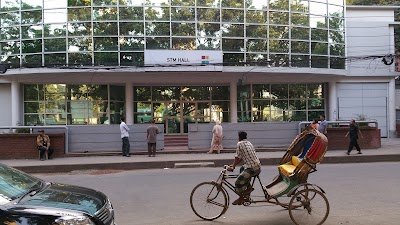
About
Location :
Added by Jopie, at 05 November 2016
Gallery


Add missing information
15 Reviews
-
30 April 2018
The origin of what today is known as the Bangladesh Institute of Management (BIM) can be traced back to 1961 when its precursor, the Management Development Center, East Pakistan, was established. BIM was in that light the Bangladesh Management Development Center (BMDC) was converted into an institute-the Bangladesh Institute of Management (BIM) opening up opportunities to offer postgraduate degree programs in Business Administration like, Executive MBA, Masters in Human Resource Management etc.
While Training, Research and Consultancy are the three mandated activities of BIM; the major thrust during the last decade has been on training and Post-Graduate Diploma Programs.There are ten specialized divisions, viz. Accounting and Financial Management, Computer Services, General Management, Marketing Management, Human Resource Management, Production Management, Consultancy and Productivity, Project and Social Service Sector, Research, Evaluation and Publication, and TOT and Behavioral Management, each headed by a Senior Management Counselor. In addition to this, there are six other sections namely Administration, Accounts, Audio Visual, Library, Maintenance and Reproduction.The BIM has two other campuses at Chittagong and Khulna, headed by two Deputy Directors.response / report this review -
21 March 2018
Bangladesh Institute of Management in short it calls BIM. It is one of the government education center, where the professionals get a degree for their respective field. They provide some professional degrees like Post Graduate Diploma in Human Resource Management (PGDHRM), Post Graduate Diploma in Marketing management (PGDMM) and many more. Their study system should be updated more.
response / report this review -
23 February 2018
Bangladesh Institute of Management (BIM) can be traced back to 1961 when its precursor, the Management Development Centre, East Pakistan, was established. It is the outcome of a tripartite project known as ‘East Pakistan Management Development, Supervisory and Instructor Training Centre’. To establish this project, a plan of operation was signed by the then Government of Pakistan, the United Nations and the International Labour Organization in 1960. The project came into being on January 1, 1961 under the administrative control of the Ministry of Health, Labour and Social Welfare (Labour and Social Welfare Division) of the then Central Government of Pakistan which was subsequently transferred to the Provincial Government of East Pakistan in December 1963.In 1970 the East Pakistan Government Educational and Training Institutions Ordinance, 1961 (East Pakistan Ordinance No. XXVI of 1961) was made applicable for Management Development Centre with effect from July 1, 1970 thereby providing the centre with autonomous status. In 1966 apart from offering short term, subject specific training programmes, a specialized, a year-long Postgraduate Diploma in Personnel Management was introduced by the Centre.
After the independence of the country in 1971, the institute was vested with the responsibility of building up human resources of the newly independent country. Between 1972 and 1975, the public sector was the predominant sector of the economy and the majority of the clients of the institute were drawn from the public sector enterprises. The institute was further involved in providing training to the members of what was proposed to be the Industrial Management Service (IMS). With gradual shift in development focus and liberalization of the economy from around 1975, there was a distinct shift in focus of the activities of BIM. The client base was also changed from a predominantly public sector to a mix of public and private sector. From the late 1970s to the mid-1980s, the institute was recipient of major Technical Assistance Projects, which resulted in a major transformation of the institute. It became a hub of management training with participants drawn from public, private and NGOs. In 1981, a one-year-long, Postgraduate Diploma in Industrial Management was introduced. In the early 1990s, the then Bangladesh Management Development Centre (BMDC) was faced with a strategic decision making situation. Due to proliferation of training institutes in both the public sector as well as NGO sector and because of limited client base, the BMDC was faced with stiff competition in the field of short, subject specific training programmes.
The number of participants per course was dwindling as were the number of courses. Against this backdrop, the BMDC took a far-reaching strategic decision to introduce a number of year long, post-graduate diploma courses. Three such academic programmes — Post-Graduate Diploma in Marketing Management, Post-Graduate Diploma in Financial Management, Post-Graduate Diploma in Computer Science were introduced. Response to these new diploma programmes, particularly for computer science, was encouraging. During early nineties, in the context of opening up of the market, structural changes and private sector driven growth strategy for rapid development, requirement for qualified human resources was anticipated. Against that backdrop the Bangladesh Management Development Centre (BMDC) started the process of restructuring itself so as to enable it to offer academic programs designed to create professionals. It was in that light the Bangladesh Management Development Centre (BMDC) was converted into an institute-the Bangladesh Institute of Management (BIM) opening up opportunities to offer postgraduate degree programs in Business Administration like, Executive MBA, Masters in Human Resource Management etc. While Training, Research and Consultancy are the three mandated activities of BIM; the major thrust during the last decaresponse / report this review -
06 February 2018
Bangladesh Institute of Management (BIM) can be traced back to 1961 when its precursor, the Management Development Centre, East Pakistan, was established. It is the outcome of a tripartite project known as ‘East Pakistan Management Development, Supervisory and Instructor Training Centre’. To establish this project, a plan of operation was signed by the then Government of Pakistan, the United Nations and the International Labour Organization in 1960. The project came into being on January 1, 1961 under the administrative control of the Ministry of Health, Labour and Social Welfare (Labour and Social Welfare Division) of the then Central Government of Pakistan which was subsequently transferred to the Provincial Government of East Pakistan in December 1963.In 1970 the East Pakistan Government Educational and Training Institutions Ordinance, 1961 (East Pakistan Ordinance No. XXVI of 1961) was made applicable for Management Development Centre with effect from July 1, 1970 thereby providing the centre with autonomous status. In 1966 apart from offering short term, subject specific training programmes, a specialized, a year-long Postgraduate Diploma in Personnel Management was introduced by the Centre.
response / report this review -
24 January 2018
The Bangladesh Institute of Management (BIM)[1][2] is a state-supported and deemed professional management University. Its headquarters is located at 4 Sobhanbag, Mirpur Road, Dhaka. Others campuses are located in Chittagong and Khulna Bangladesh. It was established in 1961.
response / report this review -
22 September 2017
The Bangladesh Institute of Management is a state supported and deemed professional management University. Its headquarter is located in 4 Sobhanbag, Mirpur Road, Dhaka. Others campuses are located in Chittagong and Khulna Bangladesh. It was established in 1961.
response / report this review -
10 August 2017
A reputed educational institution. My sister used to study there.
response / report this review -
15 July 2017
it's a very good professional Training institution. I like it.
response / report this review -
21 June 2017
Well recognized government management institute in Bangladesh. Governed by the Ministry of Industries. PGDHRM from this institution is first preference by most of the employer in Bangladesh.
response / report this review -
12 May 2017
A Brief Profile of BIM
The origin of what today is known as the Bangladesh Institute of Management (BIM) can be traced back to 1961 when its precursor, the Management Development Centre, East Pakistan, was established. It is the outcome of a tripartite project known as "East Pakistan Management Development, Supervisory and Instructor Training Centre". To establish this project, a plan of operation was signed by the then Government of Pakistan, the United Nations and ILO in 1960. The project came into being on 1.1.1961 under the administrative control of the Ministry of Health, Labour and Social Welfare (Labour and Social Welfare Division) of the then Central Government of Pakistan which was subsequently transferred to the Provincial Government of East Pakistan in December 1963.
In 1970 the East Pakistan Government Educational and Training Institutions Ordinance, 1961 (East Pakistan Ordinance No. XXVI of 1961) was made applicable for Management Development Centre with effect from 1-7-1970 thereby providing the centre with autonomous status.
In 1966 apart from offering short term, subject specific training programmes, a specialized, year long Post Graduate Diploma in Personnel Management was introduced by the Centre.
After the liberation of the country in 1971, the institute was vested with the responsibility of building up human resources of the newly independent country. Between 1972 - 75, the public sector was the predominant sector of the economy and the majority of the clients of the institute were drawn from the public sector enterprises. The institute was further involved in providing training to the members of what was proposed to be the Industrial Management Service (IMS).
With gradual shift in development focus and liberalization of the economy from around 1975, there was distinct shift in focus of the activities of BIM. The client base also changed from a predominantly public sector to a mix of public and private sector client base. During the late 70's to mid 80's, the institute was recipient of two major Technical Assistance projects, which resulted in a major transformation of the institute. It became a hub of management training with participants being drawn from public, private and NGO sectors. In the year 1981, another year long, Post Graduate Diploma in Industrial Management was introduced.
Three such academic programs i.e Post Graduate Diploma in Marketing Management, Post Graduate Diploma in Financial Management, Post Graduate Diploma in Computer Science were introduced. Response to these new diploma programs, particularly for computer science, was encouraging. During early nineties, in the context of opening up of the market, structural changes and private sector driven growth strategy for rapid development, requirement for qualified human resources was anticipated. Against that backdrop the Bangladesh Management Development Centre (BMDC) started the process of restructuring itself so as to enable it to offer academic programs designed to create professionals.
It was in that light the Bangladesh Management Development Centre (BMDC) was converted into deemed University -the Bangladesh Institute of Management (BIM) opening up opportunities to offer postgraduate degree programs in Business Administration like, Executive MBA, Masters in Human Resource Management etc.
While Training, Research and Consultancy are the three mandated activities of BIM; the major thrust during the last decade has been on training and Post-Graduate Diploma Programmes.response / report this review -
06 May 2017
Good institutions they have short, mid and long course
response / report this review -
04 May 2017
BIM, A very well know & reputed training institute.
They offer some diploma courses and short courses. I think it is the best institute for professional courses in Bangladesh.
response / report this review -
30 March 2017
Reputed and well known institution of Bangladesh. Well established organization for personal and professional training.
response / report this review -
19 March 2017
Very well known government institution for post graduation diploma and professional training.
response / report this review -
12 November 2016
BIM is one of the oldest governmental education institution in Bangladesh. It offers management related diploma courses which takes one year around through both theoretical & practical modules.
response / report this review