About
Location :
Added by Jopie, at 08 April 2017
Gallery



Add missing information
10 Reviews
-
29 May 2018
Great historical place
response / report this review -
22 May 2018
So, I went to this Mosque to see how does it look like from inside, and a very kind woman was sitting at the entrance who offered me, that she could tell extra details about this mosque and its history. It was really great that she gave me a guidance (for free)! :D
response / report this review -
14 April 2018
One of the central places where Muslims gather to pray. It's also a historical building and a monument of Ottoman architecture.
response / report this review -
03 January 2018
Una moschea, una delle tante, in centro alla città, con attiguo cimitero. Quello che è strano, rispetto alla nostra cultura, è che tutto attorno, la città viva normalmente, pertanto è facile trovare un tavolino di un bar a pochi metri da una tomba del cimitero. Un particolare che ricordo è che, tra i tanti cartelli di divieto (normalmente relativi al vestiario, all'uso di cellulari, ecc.) vi era il cartello che vieta l'ingresso alla moschea di armi da fuoco !! La moschea è visitabile, merita una sosta.
response / report this review -
31 December 2017
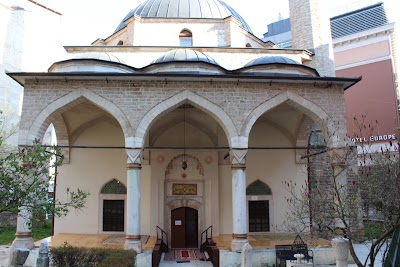
Ferhadija Mosque (Ferhad Bey’s Mosque) is located right in the center of town, on the corner of Ferhadija St. and Vladislava Skarića St., which is in close proximity to Europe Hotel, Tašlihan and Gazi Husrev Bey’s Bezistan.
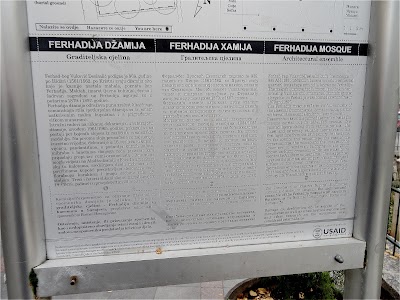
It is presumed that the mosque was erected sometime between 1561 and 1562 by the Sanjak Bey, Ferhad Bey Vuković-Desisalić. This mosque exemplifies the classical style of Ottoman architecture which was perfected during the Ottoman Empire’s “Golden Age”.
During the original construction, a mekteb (children’s school) was built alongside the mosque, as well as an imaret (public kitchen), a fountain and covered fountain, all of which went up in flames in the fires of 1679 and 1897. For this reason, there is now only a small cemetery with some twenty tombstones in the mosque’s courtyard.
The famous Sarajevo chronicler, Mula Mustafa Bašeskija, worked for a while as a teacher at the mekteb.
Ferhadija Mosque was badly damaged during the last war when several grenades struck the main cupola, causing it to be entirely removed in 2007.
Reconstruction on the mosque was carried out in two phases, the first involved repairing the damage caused by grenades and the second saw the restoration of the arabesque paintings on the walls and inverted domes.
As a result of the restoration process, works from the 16th and 17th century (Austro-Hungarian period) are now visible, as well as other artistic styles, making it possible to read more into the history of the entire structure. The oldest features to undergo restoration were the mihrab (a niche in the wall which indicates the direction of Mecca) and the lights, which date from the 16th century.
Ferhad Bey’s Mosque and the adjacent cemetery are considered a single complex, which was made a National Monument of BiH in 2004.response / report this review -
17 November 2017
There's something soothing and reassuring about these calls to prayer. It brings me back to early memories of conservative schuls -- the lilt of the liturgy, the closeness of the congregation.
response / report this review -
14 November 2017
Podigao ju je bosanski sandžak-beg Ferhad-beg Vuković-Desisalić u zlatno doba osmanskog carstva (pretpostavlja se između 1561. i 1562. godine), te stoga ova građevina odražava punu zrelost klasičnog osmanskog stila gradnje.
response / report this review -
07 October 2017
ljepa djamija svidja mi se arhitektura
response / report this review -
04 September 2017
Pure
response / report this review -
15 April 2017
Vakit namazı bittikten hemen sonra kitlenir ve önünde alkollü içki içecekler içilmektedir.
response / report this review


